
Road safety in Thailand starts before you choose a vehicle. Match the journey to your experience, use suitable restraints and protective equipment, and keep the option to change plans when weather, fatigue or traffic makes the trip unsuitable. Familiarity with a route should never replace checking the conditions on the day.
This guide gives practical preparation and response steps for residents and visitors, including passengers and pedestrians. It was reviewed on 1 November 2026. It complements the traffic-rules guide; it is not driving instruction, a medical assessment or a promise that any route or activity is safe.
Understand the risk without misreading the data
WHO's Thailand road-safety overview cites an estimated 18,218 road deaths and a rate of 25.4 per 100,000 people for 2021, reported in the 2023 global status report. It identifies motorcyclists as a particularly affected group. These are dated population estimates, not a live 2026 count or a prediction of an individual's journey.
The practical implication is to take mode choice and protection seriously. A short ride to a beach or restaurant still involves public roads. A small engine, quiet-looking street or low rental price does not establish that an inexperienced rider is ready for the conditions. Consider a suitable car, public transport or a driver when that better matches your needs.
When comparing road-safety claims, check the year, definition and source. Reported police totals, integrated national data and WHO estimates can use different methods. Avoid repeating an old “most dangerous country” ranking as current advice. What helps the reader is a clear plan to reduce exposure and obtain assistance, not a dramatic statistic without context.
Choose a mode that fits the journey
| Journey need | Questions to ask | Practical alternative to keep |
|---|---|---|
| Unfamiliar city trip | Can you navigate without handling a phone? Is parking realistic? | Rail or a suitable booked vehicle |
| Children or substantial luggage | Are correct restraints and adequate space available? | Pre-arranged vehicle meeting those needs |
| Mountain or rural route | Do your skills, vehicle and daylight margin fit the road? | Experienced driver or revised itinerary |
| Heavy rain or flooding | What do current local warnings and closures say? | Delay, reroute or cancel |
| Late arrival or long travel day | Are you rested enough to drive? | Transfer and overnight rest |
Price matters, but compare a service that actually meets the need. A car without an appropriate child restraint is not an equivalent substitute for one supplied with the correct equipment. A motorcycle ride with luggage that interferes with balance is not simply a cheaper version of the same journey.
Agree the household's limits before travelling: who will drive, when you will stop, and which conditions mean using an alternative. Planning a backup is easier while calm than while standing in heavy rain after the last planned connection. Keep enough budget for that backup rather than making every trip depend on the lowest possible fare.
Check licence, vehicle and cover together
Confirm that the driver has the recognised entitlement for the exact vehicle class. A car licence does not automatically authorise a motorcycle. Check the domestic licence and IDP requirements where relevant, and follow the licence guide for resident applications and visitor documents.
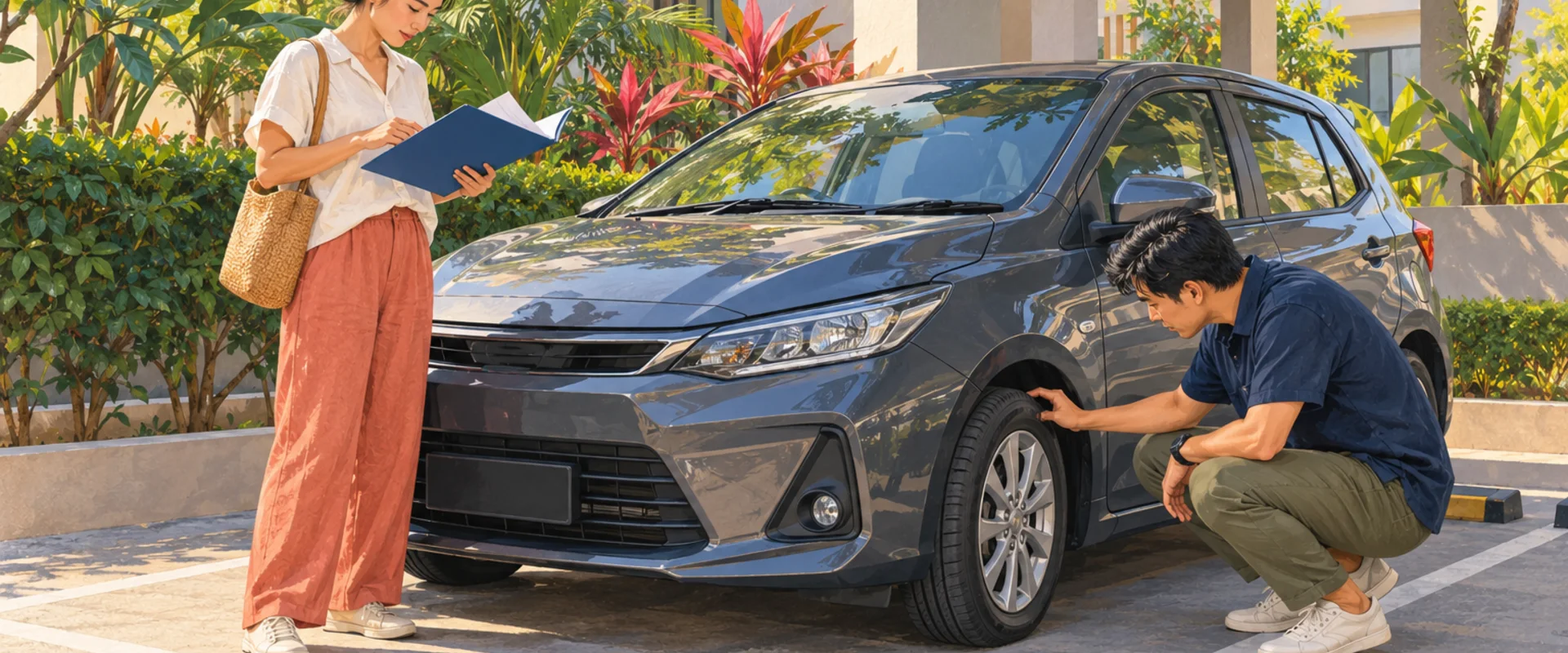
Inspect the vehicle before accepting it. Check tyres, visible damage, lights, indicators, mirrors, wipers, brakes through a safe permitted check, restraints and the condition of any supplied protective equipment. Ask the owner or rental company to resolve defects before departure. Photograph the condition and keep the agreement, but do not mistake photographs for a mechanical inspection.
Ask the insurer or rental provider about permitted drivers, use, excess, exclusions and breakdown assistance. Keep the written terms and emergency contact accessible. Cover for damage to the vehicle, injury, third-party liability and medical care can come from different arrangements; do not assume one policy pays for everything.
If something does not fit, stop the handover and clarify it. A warning light, damaged restraint or mismatched document is easier to address before leaving. Decline a vehicle you cannot operate confidently or that appears unsafe, even when changing the booking is inconvenient.
Use helmets and restraints for every relevant trip
WHO's road-traffic injury guidance identifies helmets, seat belts and child restraints among the central protective measures. They work alongside appropriate speed and sober, attentive driving; no single item makes risky behaviour harmless.
For a motorcycle, choose a suitable standards-compliant helmet that fits and can be securely fastened. Check the shell, fastening and condition rather than accepting any object offered with a rental. The passenger needs suitable protection too. Do not use an obviously damaged helmet or assume that an adult-sized item is appropriate for a child.
In a car, use the seat belt in the position provided and ensure every passenger has an appropriate place. Arrange a suitable child restraint for the child's size and the vehicle, and follow the manufacturer's installation instructions. Holding a child on a lap does not replace a restraint. Confirm equipment in advance for transfers and rentals rather than discovering a gap at pickup.
Check fit before the vehicle moves. Bags and loose objects should be secured so they do not obstruct controls or become hazards. If a booked car arrives with inadequate equipment, ask for a suitable replacement or change the plan. Do not treat the short distance to the hotel as a reason to abandon the agreed protection.
Give attention and stopping space priority
Set navigation and the route before departing. Use a safe mounting and audio arrangement where lawful, and stop in an appropriate place if a change requires your attention. Reading a message, filming a view or entering an address while controlling a vehicle takes attention away from the road. A passenger can handle those tasks when available.
Choose a speed that fits the posted limit and actual conditions, with enough space to respond to a stopped vehicle, crossing person or change in surface. A limit is not an instruction to maintain that speed in rain or poor visibility. Leave additional margin when the vehicle, road or local driving environment is unfamiliar.
Observe junctions, driveways, pedestrian areas and vehicles that may turn or stop. Do not assume eye contact or a signal guarantees another road user has understood your intention. Make your own movements clear and avoid sudden changes made only to recover a missed navigation instruction.
If you miss a turn, continue to a lawful and suitable place to change the route. Do not reverse on a fast road, cross a barrier or improvise a dangerous turn because the map suggests the destination is nearby. Arriving later is a manageable problem; an unpredictable manoeuvre can create a much larger one.
Keep alcohol, impairment and fatigue out of the plan
Arrange transport before an evening involving alcohol. Choosing not to drive avoids trying to calculate a safe amount from drink size, time or a general legal threshold. The same principle applies when illness, medication or another substance affects alertness or coordination. Ask a clinician or pharmacist about driving where treatment may impair you.
Plan long journeys with realistic rest and overnight options. Do not treat a tight hotel itinerary or an expiring rental day as a reason to continue when sleepy. If you become tired, stop somewhere appropriate and change drivers only if the other person is licensed, insured and rested.
After a long flight or overnight bus journey, consider a transfer rather than collecting a vehicle and immediately driving an unfamiliar route. Give yourself time to rest and learn the controls. A confident driver at home may still be poorly prepared after little sleep in a different traffic environment.
Passengers can support the plan by avoiding pressure to hurry and speaking up when the driver appears tired or distracted. Agree that anyone may request a stop. Build enough flexibility into the journey that the household can act on that request without arguing about a prepaid activity.
Change plans for rain, flooding and poor visibility
Check current weather and local road warnings before departure, especially for rural, mountain and flood-prone routes. A map showing an open road is not a guarantee that a recent flood or closure has been reflected. Ask the relevant local road authority or accommodation for current conditions without treating a casual assurance as official clearance.
The Department of Disaster Prevention and Mitigation's flood-driving advice warns of increased danger and recommends changing route when conditions are unsafe. Do not enter water when you cannot establish depth, road condition or current. Watching another vehicle pass does not prove your vehicle or route will be safe.
Reduce demands on yourself in heavy rain: allow more time, avoid unnecessary manoeuvres and stop at an appropriate safe location if visibility or control becomes inadequate. Do not stop in a live traffic lane to inspect a map or take photographs. Follow closures, barriers and official directions rather than attempting a shortcut through a flooded area.
After severe weather, consider damaged surfaces, debris and interrupted access as well as the rain itself. Confirm the return route and a place to stay if conditions worsen. A cancelled day trip is preferable to being committed to an unsafe return after dark.
Prepare differently for rural and mountain roads
Review the route before leaving, including distance, road type, fuel or charging, rest stops and daylight. A short distance on a map can require more time on winding or steep roads. Choose the vehicle and driver for the route rather than trying to make an unsuitable rental work because it was already booked.
Ask a qualified rental provider or instructor to explain any unfamiliar controls and manufacturer guidance for steep terrain. Avoid learning important vehicle operation while descending an unfamiliar road. If your experience is limited, use an experienced driver or a different itinerary.
Keep essential communication and location information available if mobile coverage is interrupted. Tell a trusted person your broad route and expected arrival without posting a precise live routine publicly. Carry the practical supplies appropriate to the journey and conditions, while keeping the cabin and controls clear.
Respect local restrictions, work zones and the needs of people using the road for everyday access. Do not stop on a blind bend for a photograph or block a narrow route to inspect a view. Use a designated stopping place and check that rejoining traffic can be done safely.
Take care as a passenger, pedestrian or cyclist
As a passenger, choose a vehicle with suitable seating and restraints, check the destination and raise concerns early. If driving becomes unsafe, ask to stop at an appropriate place and change the arrangement. An app rating or a professional-looking vehicle is not a reason to ignore what is happening during the actual trip.
As a pedestrian, use a suitable pavement and controlled or designated crossing where available. Check every lane and direction before entering the road, including turning traffic. A stopped vehicle in one lane does not establish that the next lane has stopped. Avoid looking at a phone while crossing or stepping out from behind a parked vehicle.
For children or residents with mobility limitations, test the route rather than assuming a nearby destination is accessible on foot. Kerbs, drainage channels, blocked pavements and long crossing distances can change the practical choice. A short vehicle trip may be more suitable than an inaccessible walking route.
For cycling, check the route, legal access, equipment and your ability to deal with the conditions. Use appropriate visibility and protection and avoid treating a road that appears on a recreational map as a segregated cycle route. If a segment exceeds your comfort or ability, change the plan rather than continuing through pressure to complete a loop.
Know what to do after a crash or breakdown
Prioritise immediate safety. If someone needs urgent medical assistance, call 1669; for a general emergency or police assistance, 191. These numbers are listed in the government's emergency contact guidance. Give the location, direction of travel, nearby landmark and what has happened, then follow the operator's instructions.
Do not put yourself in moving traffic to collect photographs or retrieve belongings. Avoid moving an injured person unless there is an immediate danger or the emergency operator directs you. Provide assistance within your ability and follow professional instructions rather than attempting unfamiliar treatment.
Contact the insurer, rental provider or breakdown service through its official number. Explain whether the vehicle can be moved and follow police and insurer directions about the scene. Record the case reference, vehicle details and relevant facts when it is safe. Keep documents and any later medical or repair records together.
Do not sign a statement you cannot understand or invent an explanation to speed up a claim. Request language assistance or clarification. For a breakdown without an immediate emergency, move to an appropriate safe location if possible and use the provider's assistance process; a warning triangle or hazard lights do not make every roadside position safe.
Make a practical pre-departure check
Before each unfamiliar trip, check five things: the driver's condition, the vehicle, every passenger's protection, the current route and the backup. Confirm fuel or charge, navigation, required documents and assistance contacts. Keep enough time to resolve a problem before setting off.
For a household, assign simple roles. One person checks the route and destination, another confirms child equipment or luggage, and the driver focuses on the vehicle and driving. Agree a meeting or contact plan if people separate. Avoid distracting the driver with competing navigation instructions.
After the trip, note any defect, near miss or route issue that should change the next journey. Report rental faults promptly and keep service records for an owned vehicle. Learning from a problem means changing the conditions that caused it, not merely congratulating yourself that nothing worse happened.
Frequently asked road-safety questions
Is a short scooter ride a good way to learn?
Public traffic is not an appropriate substitute for proper instruction and the correct entitlement. Use a legitimate training route and choose another mode until your skills, licence, equipment and cover are suitable.
Should I follow the local traffic speed if it feels too fast?
No. Follow the law and drive within conditions and your ability. If you cannot make the journey comfortably and appropriately, stop somewhere safe and reconsider the route or mode.
Can I rely on a crossing signal without looking?
No. Use the signal and crossing properly, then continue checking for traffic in every relevant direction. A signal is part of the safety process, not proof that every other road user has responded.
Does insurance make an unsafe activity acceptable?
No. Insurance terms and safe behaviour are separate questions. Confirm cover, then still choose a vehicle and journey appropriate to your ability and the conditions.
Sources, review and your next journey
Content owner: Thailand Navigator. Reviewed: 1 November 2026. This AI-assisted editorial guide uses WHO Thailand's dated road-safety overview, WHO injury-prevention guidance, DDPM flood advice and official emergency contacts. No route inspection or personal medical assessment is claimed.
For your next journey, confirm the driver and vehicle are suitable, arrange protection for every passenger, check current conditions and keep a realistic alternative. Read traffic rules for legal requirements and car insurance for policy comparisons.