
ThailandNavigator
Thailand Guide

Northern Thailand During Smoke Season

Check actual air quality, set flexible booking deadlines and decide whether to shorten, move or postpone outdoor travel in Chiang Mai and the North.

Reading time
5 min read
Reviewed
Reviewed
Editorial owner
Thailand Navigator Editorial Team
Context
Chiang Mai
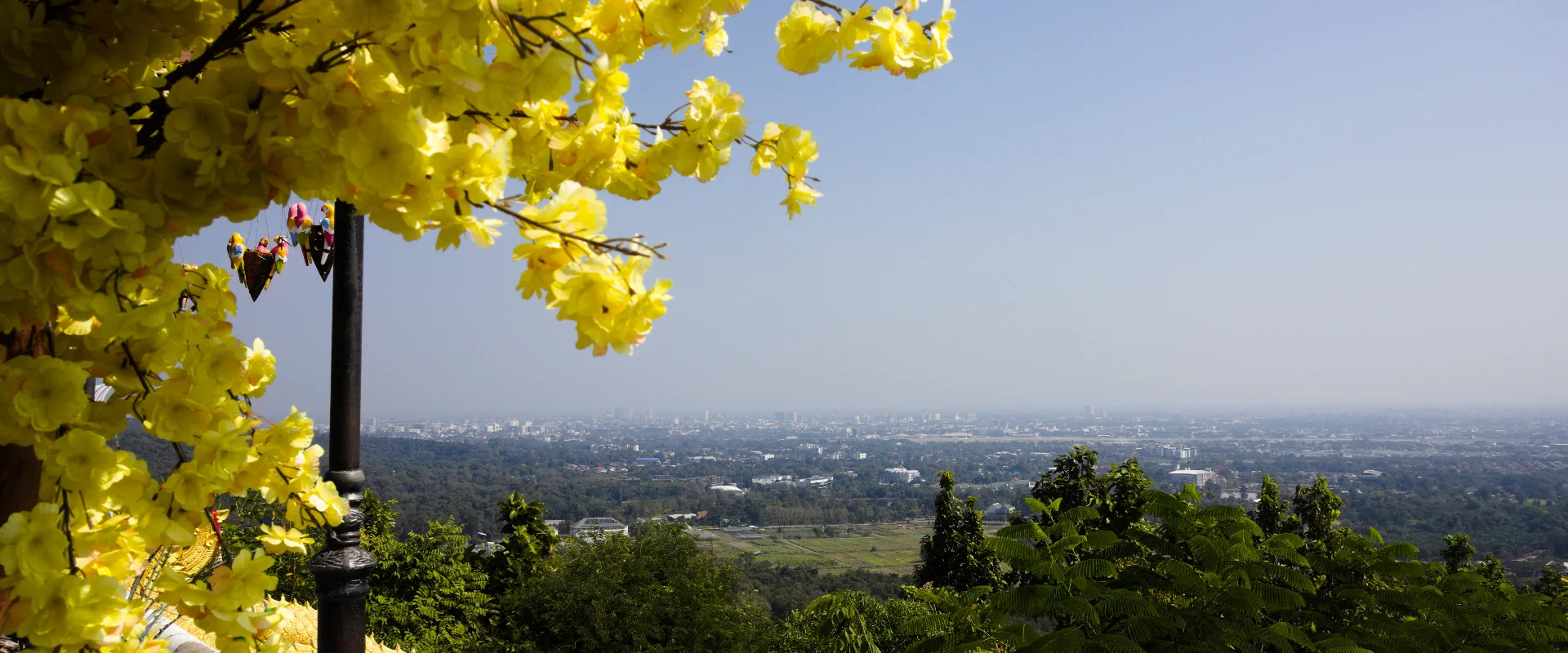
Chiang Mai spreads across the plain below Doi Suthep in a January 2025 photograph
Chiang Mai from Wat Phra That Doi Suthep in January 2025. Starfizzure, CC BY-SA 4.0 (https://creativecommons.org/licenses/by-sa/4.0/). Cropped and resized. Original on Wikimedia Commons.
This travel guide cannot assess anyone’s individual health risk. Follow local air-quality advisories and advice from your clinician.
Quick answer

Decide with station readings and your cancellation deadline

Smoke episodes are more common in the late dry season, especially March and April. Compare recent readings for each destination before you commit to a mountain or road trip.

Measure On Air4Thai, check the nearest station, its update time and the 24-hour PM2.5 value.
Book flexibly Start with cancellable nights and a changeable transfer. Save each cutoff in Thai local time.
Adapt Have one indoor day ready and compare measured conditions before moving to a different region.

Make a smoke-season decision

Choose the option that best matches your situation to see the most relevant part of this guide.

Late in the northern dry season, waves of fine particles from smoke can reduce visibility and make an outdoor itinerary a poor fit. Plan using the conditions around your hotel and activities. A reading in Chiang Mai tells you little about the exact hour and place of a hike, and a lower reading in Chiang Rai today may change by tomorrow.

1

Understand the season and your route

Start watching for episodes in February. The risk is generally more pronounced in March and April, and the timing varies with fires, winds and the arrival of rain. NASA recorded smoke across northern valleys and ridges on 22 April 2026. Air quality can also be poor outside that period. If the highlights of your trip are a long hike, cycling, panoramic photos or open-air driving, consider more flexible dates or a different month.
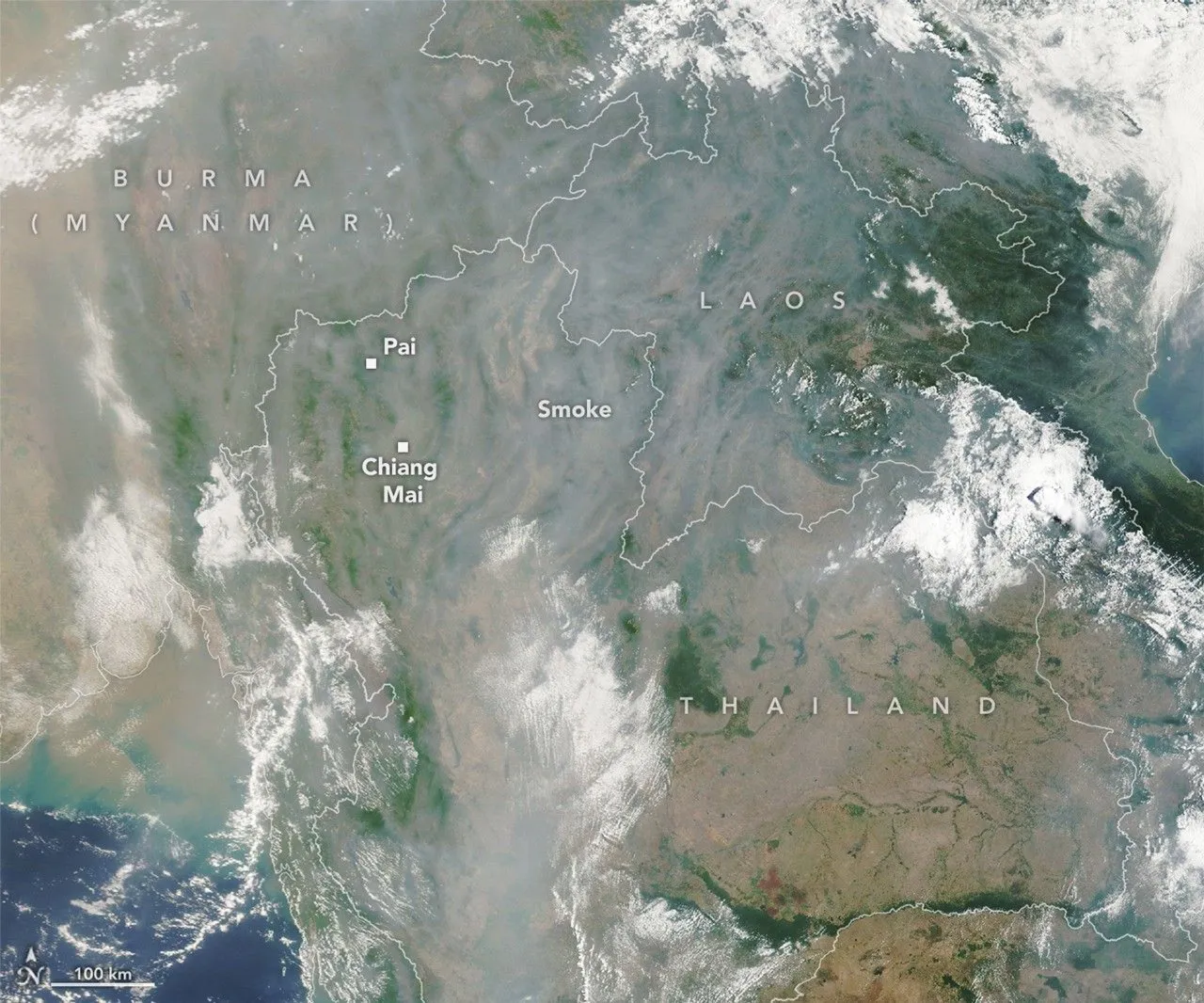
NASA satellite view of gray smoke covering northern Thailand near Pai and Chiang Mai on 22 April 2026
Smoke across northern Thailand on 22 April 2026. NASA Earth Observatory image by Lauren Dauphin, using MODIS data. Public domain. Resized.

Check Pai and Mae Hong Son individually before moving from Chiang Mai. The same episode can cover several northern provinces. An elevated viewpoint such as Doi Suthep or Doi Inthanon National Park needs its own conditions check. Cloud, haze and rain can affect visibility independently. Use the closest monitor you can find and ask the operator or park separately about access and visibility.

2

Check air quality before you book and each morning

1. Open Thailand’s official Air4Thai station map. Search for Air4Thai Pollution Control Department or open the Air4Thai app. Select the nearest reporting station to your bed and destination. For a road trip, check stops in each province rather than looking only at a citywide card. Read when each station last updated.

2. Read the pollutant, units and averaging period. Look for PM2.5 in µg/m³, especially the 24-hour average, and read the local health advice next to the station. The Thai 24-hour PM2.5 standard is 37.5 µg/m³. The Thai AQI is a separate index and may describe the highest-contributing pollutant. To compare with another app, make sure the units, time period and scale match. A Thai AQI number and a US AQI number can have different meanings.

3. Look for a trend and apply it to the planned activity. Check the latest update, recent hours or days and more than one nearby station. Use the GISTDA fire map for regional context, and the monitor plus the local advisory to judge air quality at your destination. A weather camera or good view can help you judge scenery. Use measurements for exposure decisions.

A worked decision. If your hotel-area station shows a 24-hour PM2.5 average of 47 µg/m³, that exceeds Thailand’s standard and falls in its orange PM2.5 band. Check the local guidance and the trip destination as well. Reschedule a long hike or cycling day. Check whether the replacement venue has filtered indoor air and whether exposure during the transfer makes sense for your group. Review before the outdoor booking cutoff, then again on the morning.

3

Book a trip you can still change

  • Hotels
    Start with two or three nights and a written cancellation deadline in Thai local time. Ask whether the room windows close well and whether the property supplies an appropriate portable air cleaner or filtered space. Air conditioning and particle filtration are separate features. In the Chiang Mai Old City, use short journeys and save indoor options close to your hotel.
  • Outdoor trips
    Ask the driver or guide when you can move the date, what area closures or visibly poor conditions mean for refunds and when pickup becomes chargeable. Book the long outdoor day only once you understand those terms. Save a shorter route and a practical indoor alternative.
  • Flight and rail
    Check change fees plus any fare difference at Chiang Mai Airport or Chiang Rai Airport before you rearrange a route. If using Chiang Mai Railway Station, use the Thailand by Train guide to check date, fare and refund rules. Avoid assuming a rail or air seat will be available at the last minute.
4

Change the plan when conditions get worse

For one smoky day, move strenuous outdoor activity to another date. Use a room or venue with verified indoor filtration, keep exposure to outdoor smoke shorter and minimize time waiting by open roads. The CDC recommends a properly fitted particulate respirator such as a NIOSH-approved N95 for adults who need to go out in smoky conditions. A respirator works best with a close face seal. Ask your clinician about individual suitability and travel plans if you have heart or lung disease, are pregnant or have other risk factors. Children need age-appropriate guidance. See the guide to Thailand with babies and young children for the rest of the family logistics.

For several bad days, compare live readings at your real alternatives, then calculate the effect of moving on your budget and time. If conditions are better in Bangkok, the Bangkok Art and Culture Centre or the Bangkok indoor family guide can help you replan. Hua Hin without a car gives another base to compare if its monitoring and weather look suitable. Confirm room and transport availability before cancelling your original bookings.

For symptoms, follow your clinician’s treatment plan and seek medical advice if coughing, wheezing or shortness of breath persists. Call 1669 in Thailand for a medical emergency such as severe difficulty breathing or chest pain. Keep your location and local hotel address to hand.

If you shift the trip to another season, use Where to Go in Thailand by Month and the national parks guide to check rainfall, access and trail closures before rebooking.

Sources and review

Sources used for this guide

Sources are reviewed regularly so important changes can be reflected in the guide.

Suggest content

Help us improve Thailand Navigator.
What would you like to do?

Current location: Chiang Mai

Your account, current page and submission date are recorded automatically.

Community experiences

Reviews of Northern Thailand During Smoke Season

Read first-hand experiences, then share your own.

Write a review
Loading member reviews…
Reviews reflect members’ own experiences.

Want to write a review?

Closing this prompt will not remove your rating.

Choose language

Select the language used across Thailand Navigator.

You can change this any time from the language menu.